Updated October 2026
If you’d rather swallow your CBD than hold drops under your tongue, you have two choices at OnlyPure: a cup of tea or a softgel. Both are taken by mouth. Both are digested. But they’re different products, made in different ways, for different routines.
This guide compares the two side by side. It covers what’s in each, how your body handles CBD you swallow, and how to check what you’re buying.
The two products at a glance
| CBD Relaxation Tea | CBD Softgels | |
|---|---|---|
| CBD per serving (label) | 10 mg per scoop | 10, 15, 25 or 50 mg per softgel, depending on strength |
| Servings | 30 scoops (300 mg per pouch) | 30 or 60 softgels |
| Type of CBD | CBD isolate | Full-spectrum hemp extract (contains a small amount of THC) |
| Other ingredients | Turmeric, lemon balm, reishi mushroom, cinnamon, ginger extract, black pepper extract | MCT oil, gelatin |
| Taste | Herbal tea flavor | None; swallowed whole |
| Best fit | People who like a warm drink as part of a routine | People who want the same amount every time, with no taste or prep |
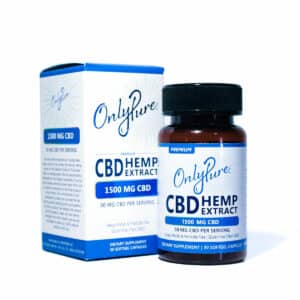
The 750 mg softgel label, for example, lists one softgel as a serving, with 25 mg of CBD. It says the extract is full-spectrum, contains less than 0.3% THC, and is “not THC free.”
How your body handles CBD you swallow
When you drink tea or swallow a capsule, the CBD goes through your digestive system and liver before it reaches your bloodstream. Along the way, the liver breaks a good share of it down into other compounds.
That breakdown doesn’t make CBD “easier to use,” as is sometimes claimed. In a trial of purified CBD in healthy adults, the main compound in the blood afterward was 7-carboxy-CBD, a breakdown product. Unchanged CBD came next, followed by 7-hydroxy-CBD, a breakdown product that is active.[2] Some breakdown products are active, and others are just on their way out of the body.
A few other points from the research:
- Timing varies widely. A systematic review of human studies found that peak blood levels were reached anywhere from 0 to 4 hours after a dose, across the routes studied.[1] In the purified-CBD trial, peak levels after a single oral dose came at about 4 to 5 hours.[2]
- Food and oil matter. The same review found that peak levels rose when CBD was taken with food and in oil-based (lipid) formulas.[1] OnlyPure softgels use MCT oil. The tea is a powder you mix into a drink. No study has compared the two products directly, so we can’t say which one your body absorbs better.
- The data are thin. The review’s authors noted a shortage of data and some disagreement between studies on how CBD is absorbed.[1]
Bottom line: oral CBD is slower and less predictable than many websites suggest. Each person’s response is different.
A slow start isn’t a safety feature
Because swallowed CBD takes a while to show up, some people take a second serving when they don’t notice anything right away. That’s the opposite of what you want. A slow onset doesn’t protect you from taking too much. It can make it easier.
Follow the serving size on your label, and don’t add more just because you haven’t felt anything yet. If you have questions about how much is right for you, ask your doctor or pharmacist.
Comparing the lab reports
Every OnlyPure product has a certificate of analysis (COA) from the Utah Department of Agriculture and Food lab. Here’s what the current reports for these two products show, and what they don’t.
CBD Relaxation Tea (lot P2024153, issued Oct 22, 2025): The report covers cannabinoids only. It lists CBD and reports Total THC as ND, meaning not detected.[6] “Not detected” means the lab didn’t find THC in that sample at its detection limit. It isn’t a promise about every batch. Because this report tests cannabinoids only, it doesn’t tell you about pesticides, heavy metals or microbes.
CBD Softgels, 750 mg (lot 250825-3, issued Mar 9, 2026): This report lists Total THC at 0.11%.[7] It also includes contaminant panels, and the pesticide and heavy-metal tests are marked PASS.[7] A PASS means results were under the lab’s action limits. It doesn’t mean “zero.”
Either way, a lab report tells you what’s in the product. It isn’t FDA approval, and it doesn’t show the product will do anything for you. You’ll find every report on our Product COAs page. Match the lot number to your package.
If you’re drug tested: in one study, half the people who took a full-spectrum CBD oil daily for four weeks tested positive for a THC metabolite.[8] The softgels contain THC. No CBD product can guarantee a negative test.
What about benefits?
You’ll see plenty of claims that CBD edibles help with sleep, pain or anxiety. The honest answer is that research on these questions is early, and results depend on the dose, the formula and the people studied.
Here’s one example. In a small 2024 trial, 30 adults with insomnia took 150 mg of CBD or a placebo each night.[3] For most sleep measures, CBD was no different from placebo. The CBD group did report greater well-being.[3] That dose is far higher than one scoop of tea or one softgel. The results can’t be applied to our products or to anyone else’s.
We’d rather tell you that plainly than promise something the research doesn’t show.
Side effects and safety
The FDA says CBD can cause liver injury, and it can change how other medicines work.[4] Combining CBD with alcohol, or with medicines that slow brain activity, raises the risk of drowsiness and injury.[4] In clinical trials, the most common side effects included diarrhea, nausea, headache and sleepiness.[2] The FDA strongly advises against CBD in any form during pregnancy or while breastfeeding.[5]
The tea also contains herbs and mushroom. If you take medicine or have a health condition, show your doctor the full ingredient list, not just the CBD amount.
Which one is right for you?
- Choose the tea if you enjoy a warm drink and want CBD to be part of that routine.
- Choose the softgels if you want no taste, no prep and the same measured amount every time, in a range of strengths.
Have a question about either product or its lab report? Contact us, or browse CBD capsules, CBD beverages or the full OnlyPure shop.
These statements have not been evaluated by the Food and Drug Administration. This product is not intended to diagnose, treat, cure or prevent any disease.
This article is general information, not medical advice. Talk to your doctor before using CBD if you take any medication, have a medical condition, or are pregnant or nursing. Not for use by anyone under 18.
Sources
- Millar SA, Stone NL, Yates AS, O’Sullivan SE. “A Systematic Review on the Pharmacokinetics of Cannabidiol in Humans.” Front Pharmacol 2018;9:1365 (PMID 30534073) — pmc.ncbi.nlm.nih.gov
- Taylor L, Gidal B, Blakey G, Tayo B, Morrison G. “A Phase I, Randomized, Double-Blind, Placebo-Controlled, Single Ascending Dose, Multiple Dose, and Food Effect Trial of the Safety, Tolerability and Pharmacokinetics of Highly Purified Cannabidiol in Healthy Subjects.” CNS Drugs 2018 (PMID 30374683; purified CBD oral solution, 750–6000 mg) — pmc.ncbi.nlm.nih.gov
- Narayan AJ, Downey LA, Rose S, Di Natale L, Hayley AC. “Cannabidiol for moderate-severe insomnia: a randomized controlled pilot trial of 150 mg of nightly dosing.” J Clin Sleep Med 2024;20(5):753-763 (PMID 38174873) — pmc.ncbi.nlm.nih.gov
- FDA — What You Need to Know (And What We’re Working to Find Out) About Products Containing Cannabis or Cannabis-derived Compounds, Including CBD — www.fda.gov
- FDA — What You Should Know About Using Cannabis, Including CBD, When Pregnant or Breastfeeding — www.fda.gov
- OnlyPure CBD Relaxation Tea COA, Utah Department of Agriculture and Food, lab # HP25293-5, lot P2024153, issued 10/22/2025 (cannabinoids only) — onlypure.com
- OnlyPure 750 mg Softgels (30 ct) COA, UDAF lab # HP26058-4, lot 250825-3, issued 03/09/2026 (full panel) — onlypure.com
- Dahlgren MK et al. “Urinary Tetrahydrocannabinol After 4 Weeks of a Full-Spectrum, High-Cannabidiol Treatment in an Open-label Clinical Trial.” JAMA Psychiatry 2021;78(3):335-337 — pmc.ncbi.nlm.nih.gov