Updated October 2026
CBD shelves are crowded, and most bottles make similar promises. The good news is that you don’t need a chemistry degree to compare them. Two documents tell you most of what you need: the product label and the lab report, often called a certificate of analysis or COA.
This checklist walks through both, using our own tincture as a worked example.
Why checking matters
Independent testing has found that what’s on a CBD label isn’t always what’s in the bottle. In a 2017 study published in JAMA, researchers bought 84 CBD products sold online from 31 companies and tested them.[3] Only about 31% were labeled accurately, meaning the measured CBD was within 10% of the label.[3] About 43% contained more CBD than stated, about 26% contained less, and THC turned up in 18 of the 84 samples.[3]
That study is now several years old and covered online products only, so it doesn’t describe every brand today. It does show why “trust, but verify” is the right attitude. The FDA also notes that some CBD products are marketed with unproven medical claims and are of unknown quality.[1]
Step 1: Read the label
A useful label answers these questions:
- How much CBD per serving, and per container? Total milligrams alone can mislead. Look for the serving size and the CBD in each serving.
- What kind of extract? Full-spectrum, broad-spectrum or isolate (see below).
- What else is in it? The carrier oil and any added ingredients.
- Is there a lot or batch number? You need it to match the bottle to a lab report.
- Are there warnings? Age limits, pregnancy, medications and THC content.
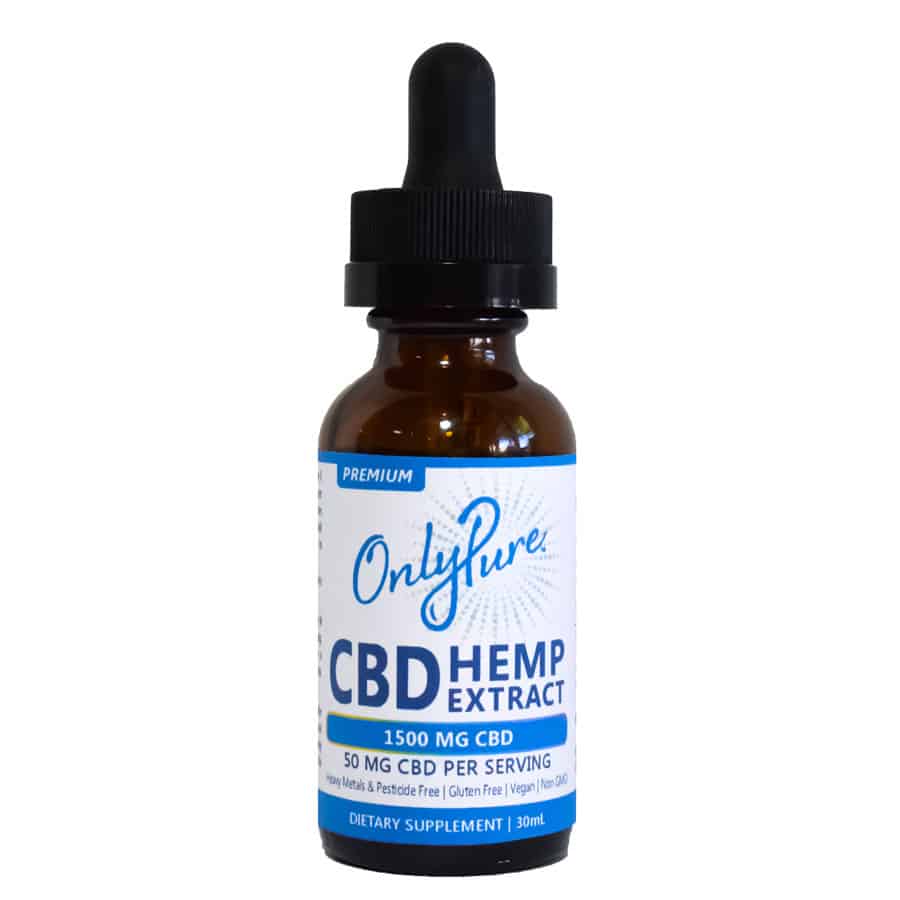
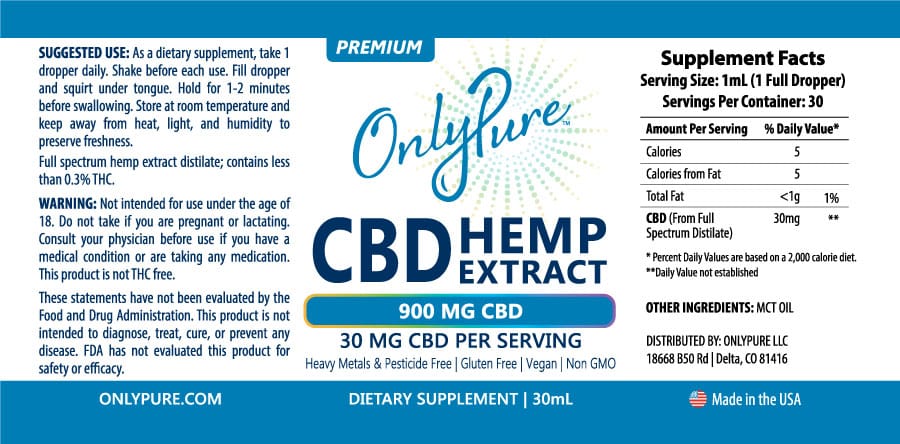
Example: our 1500 mg CBD Tincture label lists a 1 mL serving (one full dropper), 30 servings per bottle and 50 mg CBD per serving. The only other ingredient listed is MCT oil. It describes the extract as full-spectrum hemp extract distillate containing less than 0.3% THC, and it plainly states, “This product is not THC free.”
Step 2: Know the three extract types
- Full-spectrum extracts keep CBD along with other naturally occurring hemp compounds, including a small amount of THC.
- Broad-spectrum extracts are processed to reduce THC. “THC-free” on these usually means THC was not detected at that lab’s detection limit. It doesn’t mean zero, and it isn’t a drug-test guarantee.
- Isolate is CBD on its own, separated from most other plant compounds.
You’ll often hear that full-spectrum works better because of an “entourage effect,” the idea that hemp compounds work together. That’s an interesting hypothesis, but it hasn’t been proven in people. No extract type is automatically “better.” Choose based on what you want in, or out of, your product.
Spectrum also varies from product to product, even within one brand. Check each product’s label instead of assuming.
Step 3: Read the certificate of analysis
A COA is a lab’s report on a sample of a product. Here’s what to look for:
- Who did the testing? It should be a lab that doesn’t belong to the brand.
- Does it match your product? Compare the product description, strength and lot number with your bottle.
- When was it issued? A years-old report may not describe the batch you’re holding.
- What was tested? Some COAs report cannabinoids only. That tells you about CBD and THC content, but nothing about pesticides, heavy metals, solvents or microbes. A full panel covers those too.
- How are results written? “ND” means not detected. “<LOQ” means something was present but below the level the lab could measure precisely. “NT” means not tested. These are different, and “PASS” means a result was under the lab’s action limit, not that a substance is absent.
Example: the COA for our 1500 mg tincture comes from the Utah Department of Agriculture and Food lab. It covers lot 251210-2 and was issued May 15, 2026.[5] It reports cannabinoids, with Δ9-THC at 0.18% by weight, and lists PASS results for foreign matter, microbials, pesticides, heavy metals, residual solvents and mycotoxins.[5] It also shows some microbial organisms as “NT,” or not tested.[5] The lab itself notes that its results pertain only to the sample tested and are not an endorsement of a product.[5]
Step 4: Keep lab testing in perspective
Testing tells you what is in a sample. It doesn’t tell you a product is approved, safe for everyone or effective for any condition.
The FDA has approved one prescription CBD medicine, and no other drug products containing CBD.[2] The FDA has also concluded that CBD products are excluded from the definition of a dietary supplement.[2] A good COA is a sign of transparency, not a stamp of FDA approval.
Step 5: Don’t judge by extraction method alone
You’ll see claims that CO2 extraction is the “gold standard” and ethanol extraction is second-rate. In reality, both are widely used. What matters for your bottle is the measured result. A residual-solvent panel shows whether solvents remain in the finished product. For example, our 1500 mg tincture COA lists a PASS for residual solvents.[5]
Step 6: Think about drug tests and medications
If you’re drug tested, take the THC content seriously. In a small study, 14 adults reported results after using a full-spectrum, high-CBD product daily for four weeks.[4] Seven of them, half, tested positive for a THC metabolite.[4] No CBD product can guarantee a negative test, and full-spectrum products carry the most risk.
CBD can also interact with medicines. The FDA warns that CBD can cause liver injury. It also says that combining CBD with alcohol or other drugs that slow brain activity raises the risk of sedation and drowsiness.[1] If you take any medication, talk with your doctor first.
Red flags
- Claims that a product cures, treats or prevents a disease
- No COA, or a COA that doesn’t match the product, strength or lot
- A cannabinoid-only report presented as proof the product is “clean”
- No serving size or CBD-per-serving amount on the label
- Pressure to buy now, before you’ve had time to check
Good signs
- COAs that are easy to find and match the product
- Clear labels with ingredients, serving size and warnings
- Real customer reviews, and a company you can actually reach with questions
Where OnlyPure fits
We post the COA links on each product page and collect them on our Product COAs page. Compare the lot number on your package with the report, and if something doesn’t match or you have a question, contact us.
When you’re ready, browse the OnlyPure shop. Options include our CBD Tincture in 900 mg and 1500 mg strengths, CBD Softgels, a topical CBD Salve and our CBD Relaxation Tea.
These statements have not been evaluated by the Food and Drug Administration. This product is not intended to diagnose, treat, cure or prevent any disease.
Talk to your doctor before using CBD if you take any medication, have a medical condition, or are pregnant or nursing. Not for use by anyone under 18.
Sources
- FDA — What You Need to Know (And What We’re Working to Find Out) About Products Containing Cannabis or Cannabis-derived Compounds, Including CBD — www.fda.gov
- FDA — FDA Regulation of Cannabis and Cannabis-Derived Products, Including Cannabidiol (CBD): Q&A — www.fda.gov
- Bonn-Miller MO et al. “Labeling Accuracy of Cannabidiol Extracts Sold Online.” JAMA 2017;318(17):1708-1709 (PMID 29114823) — pmc.ncbi.nlm.nih.gov
- Dahlgren MK et al. “Urinary Tetrahydrocannabinol After 4 Weeks of a Full-Spectrum, High-Cannabidiol Treatment in an Open-label Clinical Trial.” JAMA Psychiatry 2021;78(3):335-337 (PMID 33146684) — pmc.ncbi.nlm.nih.gov
- OnlyPure 1500 mg Tincture COA, Utah Department of Agriculture and Food, lab # HP26131-5, lot 251210-2, issued 05/15/2026 — onlypure.com